

Rapid urbanization, housing shortages, rising construction costs, and limited development land are changing how cities think about housing. Municipalities and developers can no longer treat every residential project as an isolated building. Housing must connect efficiently with transport, utilities, healthcare, education, employment, and community services.
In this environment, modular homes are moving beyond the role of temporary accommodation. They are becoming a repeatable part of urban infrastructure: factory-produced housing units that can support affordable housing, urban infill, social housing, emergency accommodation, workforce communities, and mixed-use development.
As a Guangzhou-based modular building supplier, Aotian House provides customizable modular homes for developers, contractors, public-sector buyers, and organizations seeking faster and more scalable urban housing solutions.

Urban Housing Pressure: Why Traditional Delivery Models Are Struggling
Cities face a difficult combination of growing housing demand, expensive land, skilled-labor shortages, lengthy construction schedules, and disruption to surrounding communities.
Traditional construction can be especially challenging on small urban sites. Material storage, traffic management, noise, dust, weather delays, and limited working space can all increase project complexity.
Common challenges include:
- Long and unpredictable construction schedules
- High on-site labor requirements
- Limited space for storing materials
- Disruption to nearby residents and businesses
- Difficulty developing small or irregular urban plots
- Inconsistent construction quality
- Slow delivery of affordable and social housing
- Limited flexibility for phased expansion
If cities cannot deliver housing at the speed required, the consequences extend beyond the housing market. Workers may need to live farther from employment centers, transport pressure increases, and public services become more difficult to plan.
Housing delivery is therefore becoming an infrastructure issue rather than only a real-estate issue.
Why Modular Homes Are Becoming Part of City Infrastructure
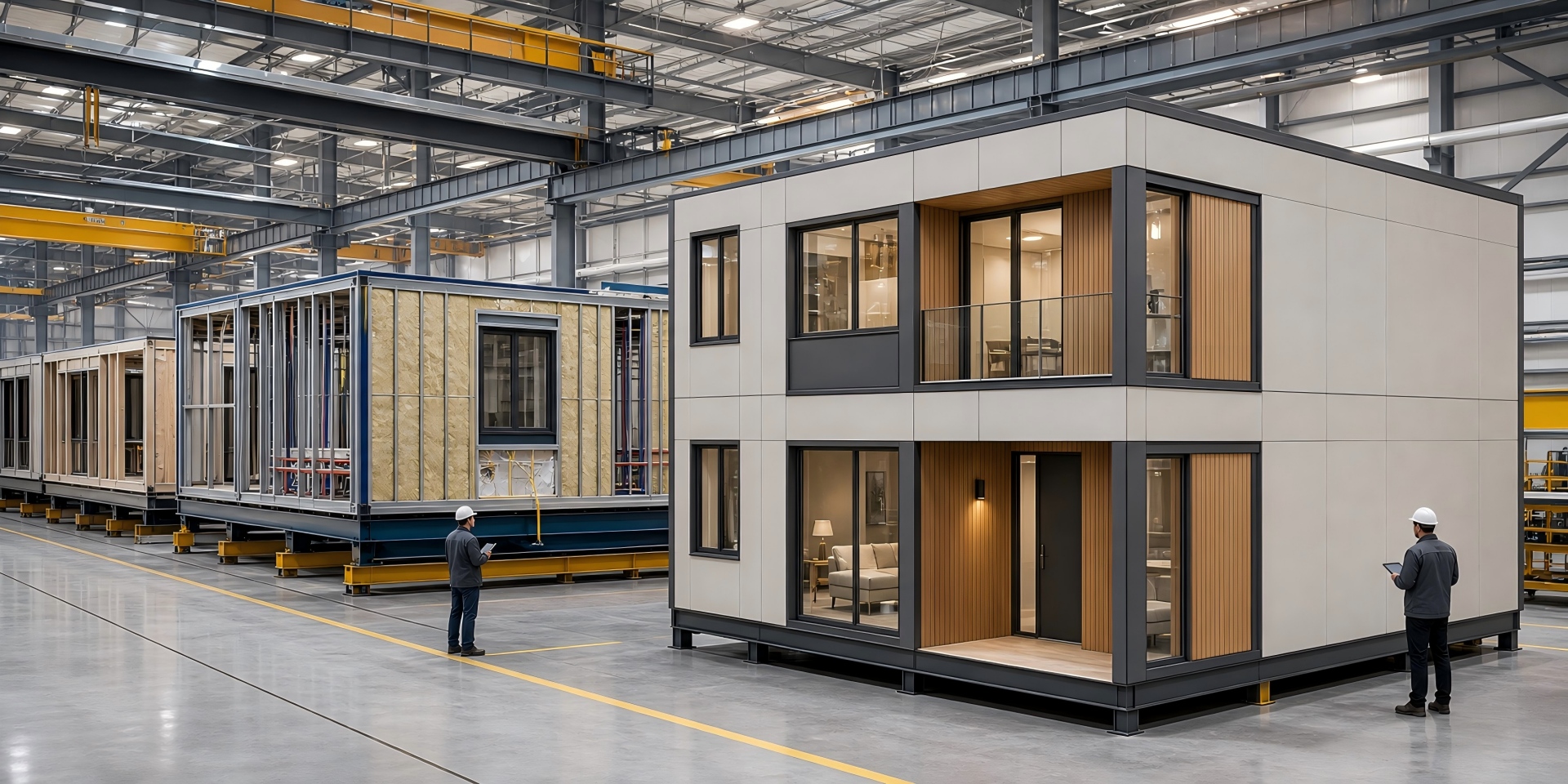
Modular homes are manufactured as panels, sections, or complete volumetric units in a controlled production environment. The finished components are then transported to the project site for assembly and connection to local infrastructure.
Research into modular construction for urban development highlights its relevance to high-density housing, standardized production, quality control, reduced on-site labor, and faster assembly.
This model gives urban developers a more predictable way to repeat housing units across multiple sites while adapting layouts, façades, and internal configurations to local requirements.
Faster Delivery for Time-Sensitive Housing Programs
Factory production allows site preparation and building manufacturing to proceed at the same time. Foundations, utility connections, drainage, and access roads can be prepared while modules are being produced.
Once the modules arrive, on-site work focuses on positioning, connecting, testing, and finishing. This can help developers reduce disruption and bring completed housing into operation sooner.
For public housing authorities and nonprofit organizations, earlier completion also means residents can access permanent accommodation sooner.
Better Use of Small and Underutilized Urban Sites
Cities often contain vacant lots, former industrial plots, parking areas, and irregular parcels that are difficult to develop efficiently through conventional methods.
Research into modular construction for urban revitalization identifies the potential of modular systems to support small or irregularly shaped urban plots.
Standardized modules can be configured as detached homes, townhouses, apartments, dormitories, clinics, community rooms, or mixed-use buildings. This gives planners more options for converting underused land into productive urban space.
Repeatable Quality Across Multiple Locations
City housing programs may involve many buildings across several neighborhoods. When every project uses a completely different construction process, controlling cost, quality, and delivery becomes difficult.
Modular production creates a repeatable platform. Structural systems, wall assemblies, windows, bathrooms, electrical services, and interior finishes can be standardized while selected features remain customizable.
For developers, this supports more consistent procurement, inspection, maintenance, and future replacement of components.
Modular Housing Must Connect with Existing City Systems
A modular home does not operate independently from the city around it. Successful projects must connect the building product with land, transportation, utilities, planning regulations, and community services.
Before selecting a modular housing system, urban developers should evaluate:
- Zoning and permitted land use
- Building-code compliance
- Fire and accessibility requirements
- Foundation conditions
- Road and crane access
- Water and sewage connections
- Electricity and communication systems
- Stormwater management
- Public transport access
- Healthcare, education, and community services
Toronto’s Modular Housing Initiative demonstrates this wider approach. Site selection considers affordable housing demand, environmental conditions, development potential, public transit, health services, community services, zoning, and site servicing.
This is what transforms modular housing from a standalone product into functioning city infrastructure.
Where Modular Homes Can Support Urban Development
Modular housing systems can serve several city needs through one adaptable construction platform.
Affordable and Social Housing
Modular homes can support public authorities, housing associations, nonprofit organizations, and private developers that need repeatable residential units with controlled specifications.
The approach is already being incorporated into government housing strategies. The New South Wales Government includes modular and volumetric dwellings within its modern methods of construction for social housing.
Urban Infill and Neighborhood Regeneration
Modular units can help add housing to vacant or underused plots without requiring large construction staging areas. Projects can be designed to fit existing streets, neighborhood scale, and architectural character.
Modular construction does not require every development to look identical. Standardized structural systems can support different façades, roof forms, colors, layouts, and public-space relationships.
Student and Workforce Accommodation
Cities with expanding universities, industrial parks, hospitals, infrastructure programs, or technology districts may need accommodation delivered close to employment and education centers.
Modular housing can support dormitories, staff residences, rental apartments, and temporary-to-permanent workforce communities.
Emergency and Transitional Housing
Cities may also need accommodation after natural disasters, during housing emergencies, or while permanent developments are being completed.
A modular system can provide private rooms, bathrooms, shared kitchens, clinics, offices, and community facilities within one coordinated project.
Aotian House: Modular Housing Solutions from Guangzhou, China
Aotian House supplies modular buildings for residential, commercial, public-service, hospitality, and workforce applications. Based in Guangzhou, China, the company can support overseas developers with product configuration, manufacturing coordination, export preparation, and installation guidance.
Available project options may include:
- Modular homes and apartments
- Container-based accommodation
- Workforce housing and dormitories
- Modular offices
- Clinics and community facilities
- Toilets and shower units
- Commercial and mixed-use modules
- Customized internal layouts
- Electrical and plumbing systems
- Exterior façade and insulation options
For urban projects, Aotian House can help buyers evaluate how module size, transport limitations, site access, climate, building use, and local regulations affect the final product configuration.
How to Choose the Right Modular Housing Manufacturer
Urban developers should evaluate more than the quoted unit price. A manufacturer must be able to support the product throughout design, manufacturing, delivery, installation, and operation.
Key evaluation criteria include:
- Structural and material specifications
- Factory quality-control procedures
- Customization capability
- Technical drawings and documentation
- Electrical and plumbing coordination
- Packaging and transport planning
- Export experience
- Installation instructions
- Spare parts and after-sales support
- Capacity for phased or repeat orders
A low initial quotation can create higher total costs if it excludes foundations, utility connections, transport protection, installation support, or essential internal systems.
The better comparison is total project value: cost, quality, delivery reliability, service life, maintenance, and the time required to place the housing into operation.

Building Urban Communities, Not Just Housing Units
Modular homes can increase housing supply, but successful urban development also depends on streets, public space, landscaping, transport, amenities, and social connection.
The relationship between modular housing and community design is explored in RICS guidance on a modular approach to placemaking. Standardized construction can still support distinctive streets and neighborhoods when architecture and public space are considered together.
For developers, the goal should not be to place isolated units on available land. It should be to create housing that becomes a durable and useful part of the city.
Conclusion
Modular homes are becoming city infrastructure because they connect industrialized production with urgent urban needs. They can support faster housing delivery, affordable housing programs, urban infill, social services, emergency accommodation, and phased neighborhood development.
Their success, however, depends on more than factory production. Developers must coordinate modular products with land, foundations, utilities, transport, planning requirements, and community services.
For cities facing housing pressure, modular construction is not a universal replacement for traditional building. It is a scalable delivery tool that can help turn underused sites and urgent housing demand into functioning urban communities.
FAQ
1.Are modular homes considered permanent buildings?
Yes. Modular homes can be designed as permanent buildings when their structure, foundations, utilities, fire safety, accessibility, and other systems comply with applicable local codes.
2.Can modular homes be used for affordable and social housing?
Yes. Modular homes can support affordable housing, social housing, transitional accommodation, student residences, and workforce housing. The final solution should be designed around local regulations and resident needs.
3.What infrastructure does a modular housing project require?
Typical requirements include foundations, road access, electricity, water, sewage, drainage, communications, fire access, and connections to transport and community services.
4.Can modular housing fit small urban sites?
Yes. Standardized modules can be configured for narrow, irregular, or underused plots. Site access, transport dimensions, crane positioning, zoning, and setbacks must be evaluated before production.
5.How can modular homes maintain neighborhood character?
Developers can customize façades, colors, roof forms, landscaping, entrances, and public-space relationships while retaining a standardized structural and production system.
Get a Modular Housing Solution for Your Urban Project
If you are planning an affordable housing program, urban infill development, workforce community, public facility, or phased residential project, Aotian House can provide a modular building solution based on your site, budget, climate, and delivery requirements.
WhatsApp: +86 139 2885 5938
Email: info@aotianhouse.com
Website: www.aotianhouse.com